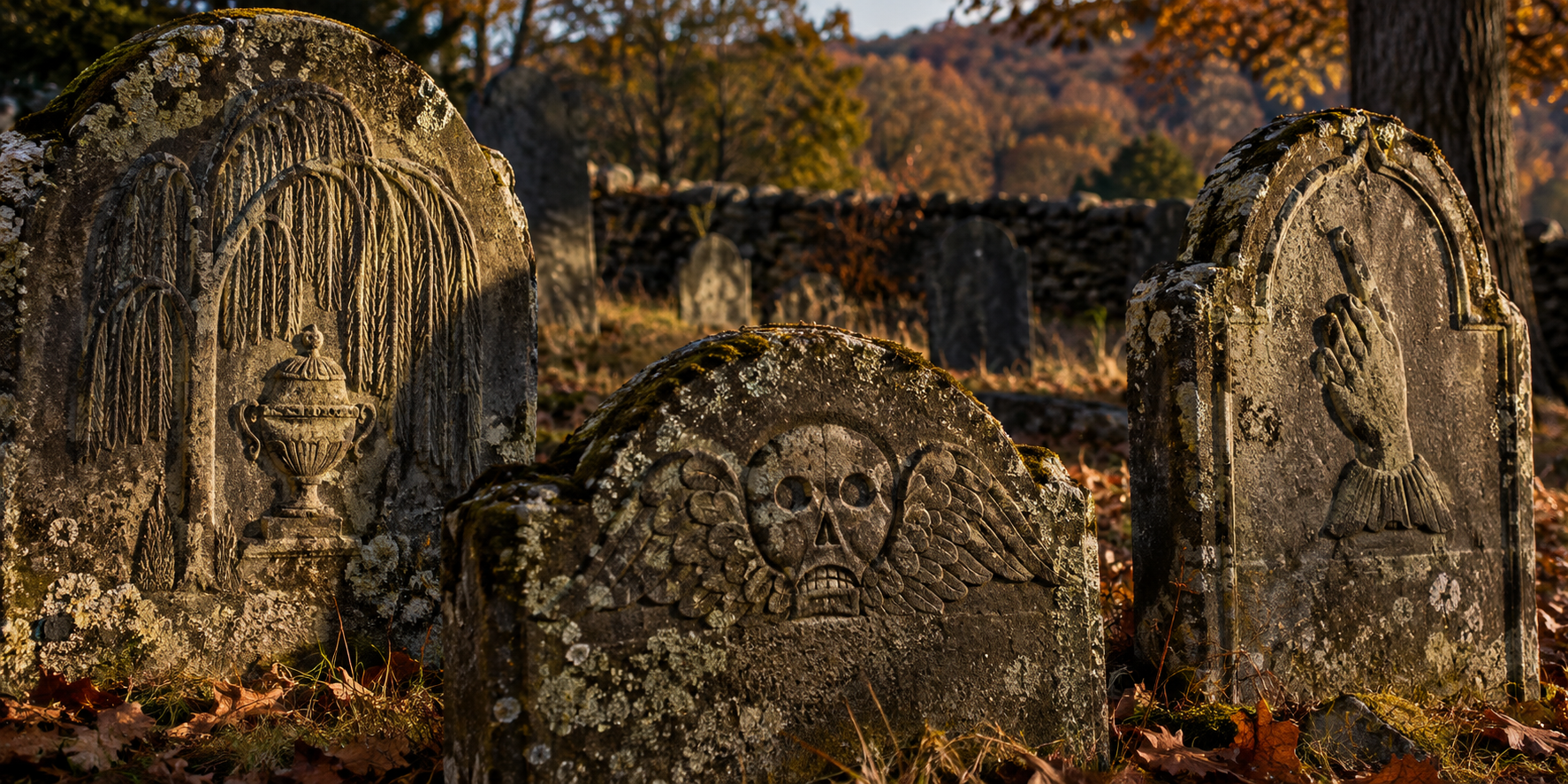
Old gravestones speak in pictures, but they do not carry a universal codebook. A willow can suggest mourning. An urn can recall classical ideas of death. A hand may point toward heaven, indicate a farewell, or belong to a fraternal emblem. Meaning depends on place, date, faith, carver, and the rest of the stone.
So treat this as a field guide, not a decoder ring.
Winged skulls and death’s heads
The winged skull is among the most recognizable motifs on colonial New England stones. It puts death directly above the name: no soft-focus clouds, no polite euphemism. In seventeenth- and early eighteenth-century burial grounds, the design often appears as a skull or stern face with wings.
The motif changed as religious and cultural ideas changed. Cherub-like faces gradually appeared, followed by more classical designs. The Smithsonian’s account of New England gravestone carving describes these markers as a major body of American folk art, shaped by local carvers rather than a single official pattern book.
The willow and urn
A drooping willow beside a lidded urn became especially common around the turn of the nineteenth century. The willow offers an unmistakable posture of grief. The urn brings classical antiquity into the cemetery, even where cremation was not practiced.
Together they mark a change in tone. The image asks visitors to mourn and remember rather than confront a grinning skull. You may find stiff early versions that look almost architectural and later ones with long branches falling around the inscription.
Pointing and clasped hands
A hand pointing upward is commonly read as ascent, heaven, or the hope of life beyond death. A hand pointing downward is not automatically sinister; it may represent a hand reaching from heaven. Look for surrounding clouds, sleeves, books, chains, or lettering before settling on an interpretation.
Clasped hands can suggest farewell, reunion, marriage, or membership in an organization. The cuffs sometimes differ to indicate two people. A broken chain near a hand may symbolize a life or family bond cut by death.
Lambs, doves, and flowers
Lambs and small reclining animals often appear on children’s markers, drawing on ideas of innocence and the biblical Lamb of God. Doves can signal peace, the soul, or the Holy Spirit. Roses may refer to beauty, love, or a life cut short, especially when the bud is broken.
Do not assume every flower is symbolic. Sometimes a rose was chosen because the family liked roses or because the monument company offered it.
Books, scrolls, and anchors
An open book may represent scripture, learning, a person’s life story, or a profession. A scroll can suggest a record completed. Anchors often carry Christian meaning through the idea of hope, though they can also point to a maritime life.
Occupation and membership matter here. A compass and square, sheaf of wheat, tent, shield, or chain links may belong to a fraternal organization rather than a general language of death.
Hourglasses, torches, and trees
An hourglass makes time visible; wings make it move faster. An inverted torch usually indicates life extinguished while the flame itself continues. Tree stumps and broken branches can represent a life cut short, but some elaborate stump markers were also tied to Woodmen of the World and similar benefit societies. The history of tree-stump markers shows how personal remembrance, nature imagery, and fraternal identity overlap.
Read the whole stone
Before assigning a meaning, record the date, location, material, inscription, nearby family stones, and repeated motifs elsewhere in the cemetery. A symbol used on six stones by one carver may tell you as much about the workshop as the dead.
Cemetery art is not a fixed alphabet. It is a conversation among grief, belief, fashion, commerce, and the hand that held the chisel.
Leave a Reply