
If you have ever been followed down a sidewalk by a scolding crow, you may have wondered whether the bird recognized you or simply objected to humanity in general.
Researchers near Seattle tested that question with wild American crows. Their field experiments showed that crows can learn a human face associated with danger and remember it for years. A follow-up study found that the warning can also reach birds that never encountered the original threat.
The crows were not subtle about it.
The experiment with the dangerous face
In a series of field experiments near Seattle, researchers wore distinctive rubber masks while trapping, banding, and releasing wild American crows. The trapping was brief, but it gave the birds a clear reason to associate the mask with an unpleasant experience.
Later, people wearing the same “dangerous” masks walked through the study areas. They varied in height, age, gender, clothing, gait, and other visible traits. The crows still responded to the mask.
Their response was difficult to misread. They scolded the masked person with harsh calls, followed them, and sometimes gathered other crows to join the commotion. Neutral masks and unmasked people drew far less attention.
This matters because it helps separate recognition of facial features from recognition of a particular body, walk, or outfit. The mask stayed the same while the person beneath it changed. The crows kept their objections properly filed.
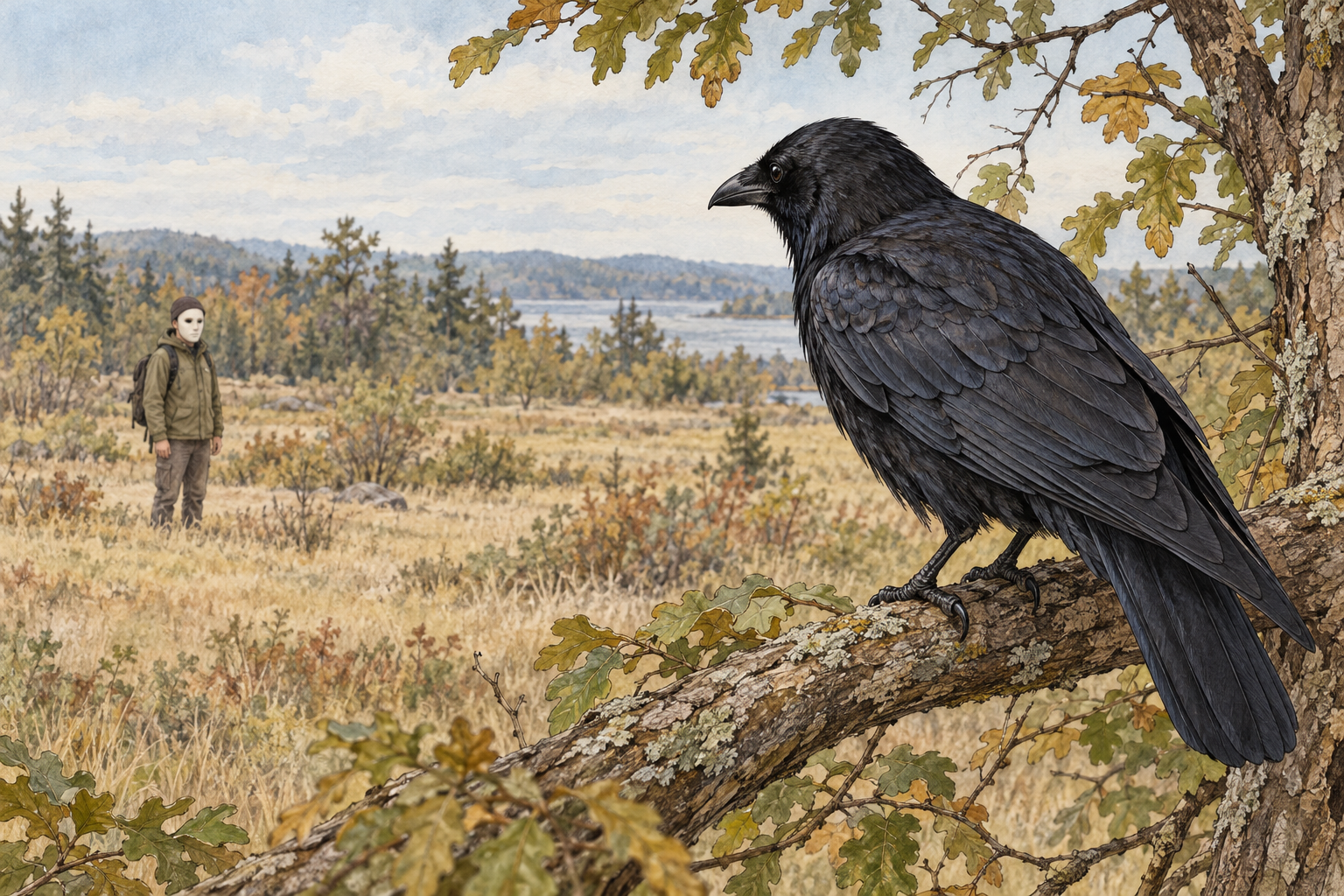
The initial study found that wild American crows could remember the threatening face for at least 2.7 years. That is the length demonstrated in the published experiment, rather than a claim about the absolute limit of crow memory.
Recognition is not quite the same as revenge
It is tempting to describe this behavior as a grudge. The word is vivid, familiar, and perhaps a little flattering to everyone involved. It gives the crow a motive and the human a starring role.
The research supports a more precise description: threat recognition and learned avoidance.
A crow that remembers a face associated with capture is not necessarily brooding over an insult. It is using past experience to make a decision about present risk. For a long-lived, social animal sharing cities and farms with unpredictable humans, that is useful information.
Some people put out food. Some ignore the birds. Some chase, trap, or harm them. Treating every human as equally safe would be poor field judgment.
Calling the behavior “revenge” also skips over what the crows actually did. Their scolding and mobbing can warn other birds, recruit help, and make a potential threat conspicuous. Noise is part of the defense.
Crows learn from one another
The story becomes stranger when the information leaves the bird that first learned it.
In a follow-up study, researchers tracked how responses to the dangerous mask spread through local crow populations. Birds that had never been trapped later scolded the masked person. Young crows also learned the response from their parents.
At one study site, scolding became twice as frequent and spread at least 1.2 kilometers from where the trapping began over five years. Crows with direct experience distinguished between dangerous and neutral masks more precisely than birds that learned socially, but the secondhand information still changed behavior.
This is social learning: one animal gains useful information by observing another. It saves the learner from having to make every expensive mistake personally, a system humans have also found convenient.
For crows, the lesson can move horizontally among nearby birds and vertically from parents to young. A bird can therefore inherit a warning about a person it has never met.
That does not mean every crow in a city maintains the same permanent list of enemies. It means threat information can travel through crow relationships and persist beyond the original encounter.
What happens in the crow brain?
Researchers have also studied what happens when crows see people associated with different experiences.
In one brain-imaging experiment, adult male crows were exposed to a mask worn during capture and another mask worn by caregivers who fed them during a period in captivity. The birds did not process the two familiar faces in the same way.
The threatening face activated regions associated with attention, fear learning, motivation, and escape behavior. The caregiving face produced a different pattern involving motivational and striatal regions.
The experiment does not mean a crow brain works exactly like a human brain. It does show that the birds connect visual information about a human face with the emotional and practical meaning of earlier encounters.
They are not merely noticing that a face is familiar. They are remembering what happened when it appeared.
Can a crow recognize you without a mask?
The experiments used masks because researchers needed a reliable way to control the face while changing other variables. That makes the evidence stronger, but it also sets a boundary around what the study proves.
The work shows that crows can discriminate among human facial features and associate a particular face with danger. It does not show that every crow notices every individual human, remembers all casual encounters, or reacts to faces without using any other clues.
In ordinary life, a crow may have more information available: your route, voice, posture, car, dog, usual time of day, and whether you arrive carrying peanuts or a ladder. Faces are part of the picture. They may not be the only part.
Do crows remember kind people too?
The brain-imaging experiment shows that crows can associate a familiar face with caretaking as well as capture. That makes it reasonable to say they distinguish people connected with different kinds of experience.
Still, popular stories about crows bringing gifts, adopting human friends, or appointing themselves neighborhood security should be treated as observations rather than universal rules. A good anecdote can be true without proving that all crows behave the same way.
If you keep field notes on neighborhood birds, the Wordless Crows journal is a fitting place to record dates, locations, calls, and behavior.
If you feed crows, consistency and restraint matter more than trying to manufacture a friendship. Keep food modest, avoid creating conflicts with neighbors or wildlife, and check local rules. Wild birds are not obligated to become supporting characters in anyone’s personal mythology.
What should you do if crows scold you?
First, consider what is happening nearby.
A crow may be responding to a nest, a fledgling on the ground, a predator, a dead crow, or another source of danger. The noise may not be a verdict on your character.
Give the birds space. Do not approach a fledgling simply because it is on the ground; young crows commonly leave the nest before they are strong fliers, and their family may be watching. Bring pets inside or move them away. Change your route for a while if the crows repeatedly react in the same place.
Do not throw objects, wave at the birds, or try to frighten them into silence. Escalating the encounter gives them better evidence that you belong in the dangerous category.
If your previous behavior caused the response, stop doing it. Crow diplomacy begins with becoming less interesting.
The useful truth behind the legend
So, do crows remember faces?
Yes. Controlled field experiments show that American crows can learn a human face associated with danger, distinguish it from neutral faces, and remember it for years. Other crows can learn about that face by watching their companions and parents.
The science is impressive without turning the birds into tiny feathered humans. Crows do not need our motives to be fascinating. They have their own social lives, risks, memories, and methods for deciding who deserves attention.
Walk gently through their territory. They are paying attention, and the minutes may be taken.
Leave a Reply